Guides / Cuts and Grain
Half-Round and Back-Cut Veneer: How Flitches Are Sliced and What You Receive
October 23, 2026
A tree trunk is round, and a veneer leaf is flat. How the log is mounted against the knife decides which part of the growth rings the blade crosses, and that decides what the face looks like. Plain slicing, quarter slicing, rift slicing and rotary peeling are the names most buyers know. Half-round slicing sits between them and is easy to confuse with rotary on a supplier sheet. The term “back-cut” adds another layer of confusion, because mills do not agree on what it means.
This guide explains what happens at the slicer, what the figure looks like, how half-round compares with the other cuts and what to ask for so the leaves that arrive match the sample you approved.
How a flitch is made
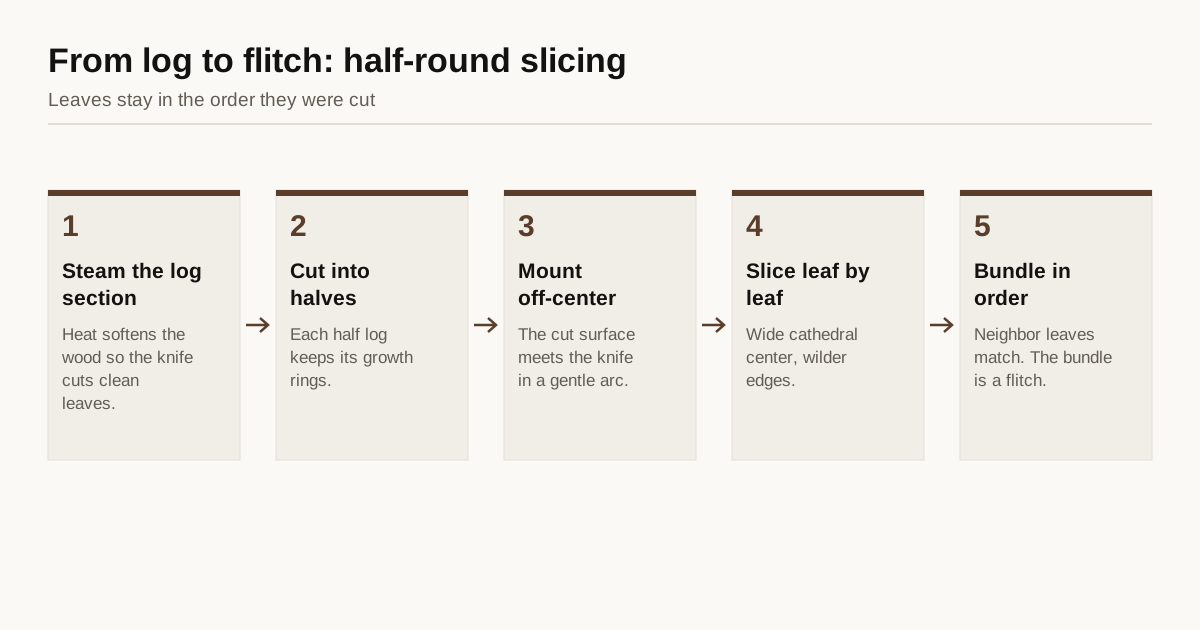
Before slicing, the log is cut into sections and softened with heat, usually by steaming or hot-water soaking, so the knife can cut a clean thin leaf without splitting the wood. The section is then cut lengthwise into halves, quarters or flat-sawn blocks, and each piece is mounted on the slicing machine.
The leaves that come off the machine are stacked in the exact order they were sliced. That bundle is a flitch. Keeping the leaves in order is the whole point of a flitch, because neighboring leaves look almost the same and can be matched into larger faces. A flitch is therefore described by a flitch number and a leaf count, not just by species and size.
The way the block is mounted gives each cut its name. A flat block with the cut running tangent to the rings gives plain-sliced or flat-cut veneer. A quarter block cut across the rings gives quarter-sliced veneer. For a deeper walk through those cuts, see the comparison of rotary, plain-sliced, quarter and rift cuts.
What half-round slicing does
In half-round slicing the half log is mounted off-center on a stay log or in a mounting frame, so the knife passes across the cut surface in a gentle arc rather than a straight line. Because the blade crosses the growth rings at a slightly different angle through the stroke, each leaf shows a broad, shifting figure. The center of the leaf carries a wide cathedral pattern, and the edges show wilder and more varied grain, with the figure changing along the length of the leaf.
The result sits between plain-sliced and rotary in appearance. Plain-sliced leaves tend to look more regular, with a repeating cathedral. Rotary leaves look the boldest and the least orderly. Half-round leaves keep some of the dramatic character of rotary while remaining a flitch, which means leaves can be taken in sequence and matched.
For buyers the practical differences are these:
- Leaf width is often wider than quarter-sliced, so fewer splices are needed per face.
- The figure changes along the leaf, so a flitch is less uniform than a plain-sliced one.
- Sequence matching works, though visual variation from leaf to leaf is greater.
- Faces look more varied than a quarter-sliced run, so check the sample against what the design needs.
Where “back-cut” fits
“Back-cut” appears on some supplier sheets and quotes. There is no single industry definition, and different mills use it in different ways. In some places it describes veneer cut from the outer, rounded side of a flitch block. In others it is used as another name for half-round, or for a flat cut that produces a wide figure from the back of the log section.
Because the word is loose, treat it as a prompt for a question, not a spec. Ask the supplier three things:
- How is the block mounted for this cut?
- Is the figure closer to a plain-sliced cathedral or to a rotary pattern?
- Can you send a leaf or a photo of the actual flitch?
A written answer, plus a sample from the lot you will receive, is worth more than a label. If a supplier cannot explain the cut in plain terms, that tells you something about how closely the stock will be controlled.
Comparing the cuts
| Cut | How the block is mounted | Typical figure | Leaf width | Sequence matching |
|---|---|---|---|---|
| Plain-sliced | Flat block, knife tangent to rings | Regular cathedral | Medium to wide | Yes |
| Quarter-sliced | Quarter block, knife across rings | Straight stripe, ray fleck in some species | Narrower | Yes |
| Rift | Quarter block at an angle | Tight straight grain, little fleck | Narrower | Yes |
| Half-round | Half log off-center | Wide, shifting cathedral with wilder edges | Wide | Yes |
| Rotary | Whole log peeled | Bold, irregular, no repeat | Very wide | No, random faces |
Leaf width and figure depend on the species and the log, so treat these descriptions as typical and not guaranteed. Walnut, for example, can show strong color variation at the edges whichever cut is used.
When half-round is a good choice
Half-round slicing suits work where a lively, natural figure is the goal and where a perfectly uniform face is not. Wall paneling and large furniture panels often use it because the wide leaves cover area in fewer pieces. Flush doors, casework faces and architectural panels can all use it if the variation is acceptable to the designer.
It is a poor fit where strict uniformity is required. A fixture program that needs the same look in every store, or a run of identical cabinet doors, will see more variation from leaf to leaf than a quarter-sliced flitch would give. In those cases, quarter-sliced stock, rift-cut stock or reconstituted veneer, controls variation better. The guide on reconstituted veneer versus natural veneer covers when engineered stock is the safer choice.
For wall panels and furniture, the guide on veneer for cabinets, wall panels and furniture lays out how each use maps to a cut and a match.
What to put on the order
If you want half-round stock, say so, and add enough detail that a supplier cannot read the cut two ways. A good order line includes:
- Species and cut: for example, “walnut, half-round sliced”.
- Flitch handling: leaves in slicing order, from one flitch, with the flitch number recorded.
- Leaf size: minimum width and length, since half-round leaves vary along the length.
- Grade: how much sapwood, knots and color variation are acceptable.
- Match type: book, slip or random.
- Sample: a leaf from the same flitch before the full order ships.
Ask whether the flitch is sold as a whole or can be split. If you need only part of a flitch, check that the remaining leaves stay together. Buying from the middle of a flitch can leave you with leaves that do not match the earlier or later ones sold to someone else.
When you receive the stock, count the leaves and confirm the order. A bundle that has been reshuffled in transit will not match, and it is much easier to catch that before pressing. The veneer shipment inspection guide covers that check.
The cut and, if it matters, the slicing method go on the spec line described in our guide to veneer specification.
Storing and handling a flitch
A flitch is only useful while its leaves stay in order. Keep the bundle tied, label it with the flitch number and store it flat, because leaves that cup or shift lose their sequence. Veneer is thin enough to react to humidity within days, so keep the stack covered and away from direct light and drafts. The guide to storing wood veneer covers rack, cover and climate points.
If you press several jobs from one flitch over weeks, pull leaves from the top of the bundle in order and mark the last leaf used. That gives you a record of where the match stops, which helps when a later job needs the next leaves in line.
A short checklist
- Name the cut in words, not just a label like “back-cut”.
- Ask for leaves in slicing order from one flitch.
- Request a leaf or a clear photo of the actual flitch.
- Specify minimum leaf width and length.
- Decide whether natural variation across leaves is acceptable for the job.
- Label and store the flitch flat as soon as it arrives.
When you know the species and cut you need, send the details on the RFQ page. The request goes to up to three suppliers that stock that species in that form, and they reply within 24 business hours.
Frequently asked questions
What is the difference between half-round and rotary veneer?
Rotary veneer is peeled in one continuous sheet as the log spins against a knife, which gives wide leaves with a bold, irregular figure. Half-round slicing cuts a half log in a shallower arc, so the leaves are shorter in the repeat of the figure and are kept in sequence as a flitch. Half-round leaves can be matched; rotary sheets are usually used as random faces.
Can half-round veneer be book matched?
Yes, but each leaf has a wide cathedral center and wilder edges, so the match reads differently from a plain-sliced match. Sequence control matters more, because the figure changes from one leaf to the next. Ask for leaves in slicing order from one flitch.
Is 'back-cut' a standard veneer term?
It is not used the same way by every mill. Some use it for slicing from the outer or rounded side of a flitch and some use it as another name for half-round. Do not rely on the word alone. Ask the supplier to describe the cut and send a photo or sample of the face you will receive.
Know what you need? Send the spec.
Tell us the species, cut, form and square footage. We pass it to up to 3 veneer suppliers that stock it and reply within 24 business hours.
Send my veneer RFQ