Guides / Choosing a Supplier
Reconstituted Veneer vs Natural Veneer: What Changes on the Spec Sheet
October 30, 2026
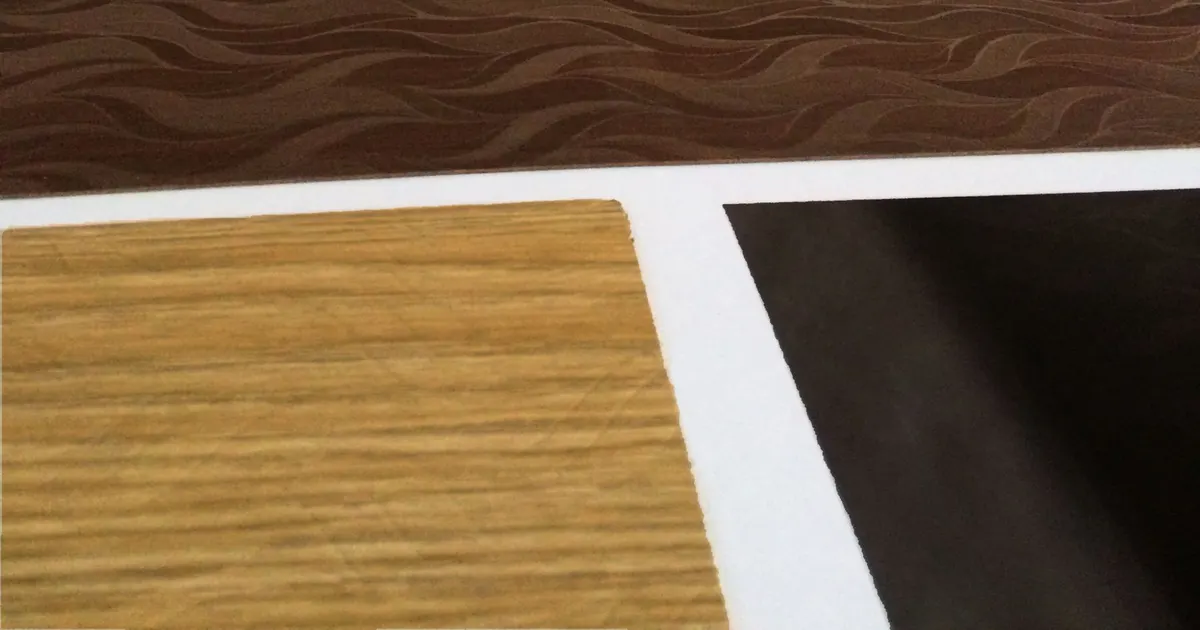
Walk through any veneer showroom and some of the sheets will look too consistent to have grown that way. They did not. Reconstituted veneer, also called recon, engineered veneer or reformed veneer, is made from real wood that has been broken down into a controlled pattern and sliced again. It looks like a perfect version of a timber that either does not exist or cannot be supplied at that quality.
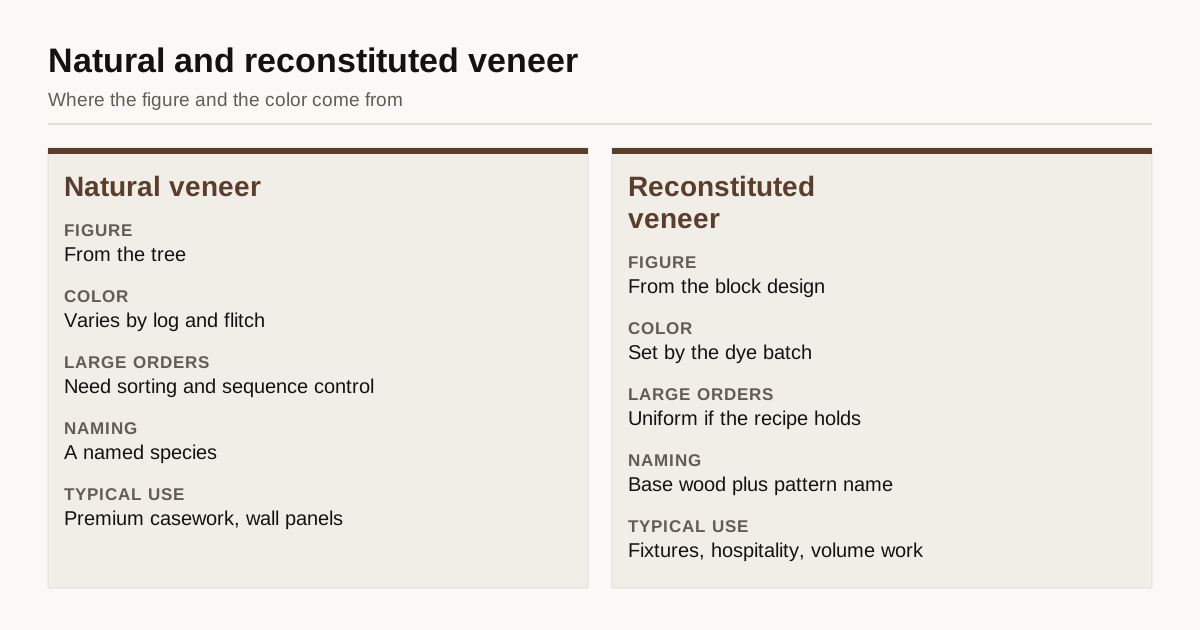
The choice between reconstituted and natural veneer is a spec decision more than a taste decision. It changes color control, repeat orders, waste, price and the paperwork that follows the wood. This guide compares them on the points that matter when you write an RFQ.
How each is made
Natural veneer comes from a log. The log is sliced or peeled into leaves, and the figure belongs to the tree: its rings, rays, knots, sapwood and color. Every flitch is different, and the supplier sorts and grades what the log yields.
Reconstituted veneer starts with fast-growing, light-colored wood, with poplar and ayous among the common choices. The logs are peeled into sheets, dyed to a chosen color, stacked and glued into a large block. The block is then cut along the stack at a set angle and sliced into leaves. Because the layers repeat, each leaf shows a regular pattern of lines, a crown or a designed figure. A maker can produce a straight-line “quarter” look, a crown look or a dyed dark tone without relying on a particular log.
The process shows why the product is consistent. The color comes from a dye batch, and the figure comes from the block design. Neither depends on what a tree decided to grow.
What you gain with reconstituted veneer
Color and figure consistency. A block yields many leaves of the same design, so a large order stays uniform. This is useful for fixtures, hotel rooms and any program where hundreds of panels must match.
Yield. Natural veneer has defects, color variation and narrow leaves that increase waste. Reconstituted leaves are commonly sold in long, wide sizes with uniform quality, so waste at the press is lower. Exact sizes vary by maker, so check the leaf dimensions and not just the pattern name.
Supply and price stability. A reconstituted look of a rare or expensive species can be made from a plentiful base wood. That frees a project from a thin supply of the real species, and prices tend to move less with log markets. The pricing guide in wood veneer pricing factors shows how species and grade drive cost in natural stock.
Design range. Makers offer colors that do not occur in nature, such as certain dark tones, strong stripes and tight patterns. Some designers want that range.
What you give up
Real figure. A reconstituted leaf repeats. Over a large wall, a viewer may spot the pattern, whereas natural veneer shows a different design on each leaf. For luxury work, a designer may prefer the variation of natural wood.
Authenticity. Reconstituted veneer is not the species it imitates, and labeling should say so. A face described as “walnut look” should not be sold as walnut. Spec sheets should name the product and the base wood.
Natural character. Rays, pores and texture are less lively in many reconstituted products. Light plays on natural veneer differently, and some finishes look flatter on recon.
Repeat-order risk if the recipe changes. The pattern name belongs to the maker. If the maker alters the dye or the block, a repeat order can drift in tone. Natural veneer drifts too, but buyers expect it to. Ask whether the maker holds the recipe steady and keep a sealed reference sample.
Side-by-side
| Factor | Natural veneer | Reconstituted veneer |
|---|---|---|
| Source of figure | The tree | The block design |
| Color control | Varies by log and flitch | Set by dye batch |
| Consistency across a large order | Needs sorting and sequence control | High if the recipe holds |
| Typical waste at the press | Higher, due to defects and narrow leaves | Lower, due to uniform sizes |
| Species claim | Named species | Base wood plus pattern name |
| Cut options | Plain, quarter, rift, half-round, rotary | Made patterns such as straight line and crown |
| Typical use | Premium casework, wall panels, furniture | Fixtures, hospitality, volume programs |
Treat these as general tendencies. Individual makers and species differ.
Finishing and processing
Reconstituted veneer presses and finishes much like natural veneer, with a few differences. The glue bond across a stacked block can be sensitive to moisture and heat, so check the maker’s data on pressing. Dye can fade or shift under strong light, so confirm light-fastness for installations with sun exposure. Sanding behaves like natural wood of the base species, but a deep cut can reveal the glue lines of the block, so face thickness and sanding limits matter. The guide on sand-through risk and face thickness explains how to protect a thin face.
Stain behaves differently, because dyed wood does not absorb stain as natural wood does. Test the finish on a sample from the real lot, not just on the catalog swatch.
Cost and lead time
Price depends on the species or pattern, the thickness and the backing, and no table can set it for you. In general, reconstituted veneer is bought from a limited set of makers and held in stock in standard patterns, so lead times for common patterns can be short. Natural veneer lead times depend on the species, the flitch and the supplier’s stock, and a specific log or a rare species can take weeks. The guide to veneer lead times shows what drives the wait.
Custom colors and patterns are the exception. A new color needs a new dye batch and a new block, so a custom recon order can take longer than a stock natural flitch. Ask for lead time in writing and compare it with your launch date.
Paperwork and legality
A pattern name tells you nothing about origin. Rules about timber legality, declarations and chain-of-custody claims usually apply to the base wood, whatever the product is called. Ask the maker for the base species, the source region and the documents your market requires. The guide to veneer paperwork covers the common frameworks. This is not legal advice, and requirements vary by country and by product.
Certification claims such as FSC or PEFC must be backed by documents that cover the product you buy. Ask for copies and check that they match the supplier and the lot.
When to choose each
Choose natural veneer when the project values the real character of a named species, when each panel is meant to look unique or when the client expects a real timber on the spec. Premium furniture, boardrooms and showpiece walls usually fall here.
Choose reconstituted veneer when the project needs uniform color across hundreds of identical items, when the species is scarce or costly or when the design calls for a made pattern. Retail fixtures, hotel casegoods and volume furniture often fall here. The guide to veneer for retail fixtures and store millwork covers how rollouts use lot control.
Some projects mix both: natural veneer on show faces and reconstituted veneer on secondary surfaces, or natural veneer in public areas and recon in back-of-house.
What to write on an RFQ
Whichever you choose, state it in terms the supplier can quote:
- Product type: natural or reconstituted, and the pattern or species name.
- Base species for recon, and the pattern code if the maker uses one.
- Leaf size and sheet form: raw, paper-backed or wood-backed.
- Quantity with waste allowance and a note on repeat orders.
- Finish plan: stain, clear or paint.
- Paperwork needed for your market.
- A sample from the lot you will receive.
Ask for a sealed reference sample at the first order. For repeat orders, compare the new lot with the sealed sample before pressing. The sample checklist lists what to check.
Checklist
- Decide whether you need real character or controlled consistency.
- Name the base species and pattern for recon.
- Confirm leaf sizes and finished thickness.
- Ask about light-fastness and finish behavior.
- Collect the paperwork your market requires.
- Keep a sealed sample for repeat orders.
When you know which type fits, send the details on the RFQ page. The request goes to up to three suppliers that stock that species or pattern in that form, with a reply within 24 business hours.
Frequently asked questions
Is reconstituted veneer real wood?
Yes, it is made from real wood. Logs of fast-growing species are peeled, dyed, glued into blocks and sliced again, so the leaf is wood but the figure is designed and not the tree's own. Ask the supplier which base species is used and how the block is made.
Why is reconstituted veneer more consistent than natural veneer?
The pattern is built into the block, so each leaf sliced from it repeats the same design, and the color comes from dye in a controlled batch. Natural veneer varies from log to log and even leaf to leaf. Consistency across lots still depends on the supplier keeping the same recipe, so confirm it for repeat orders.
Does reconstituted veneer need different paperwork from natural veneer?
It can. Timber legality rules, chain-of-custody claims and species declarations may apply to the base wood, and the made-up pattern name tells you nothing about origin. Ask for the base species and the documents your market requires, and see the paperwork guide for the usual rules.
Know what you need? Send the spec.
Tell us the species, cut, form and square footage. We pass it to up to 3 veneer suppliers that stock it and reply within 24 business hours.
Send my veneer RFQ