Guides / Cuts and Grain
Fumed, Smoked and Dyed Veneer: How Color Is Changed and What to Check
October 15, 2026
Natural wood comes in a limited color range. Oak is tan to light brown, walnut is brown to dark chocolate, maple is cream. A designer who wants a deep gray-brown, an ebony-like black or a bold green has two choices: stain the finished panel or buy veneer whose color has already been changed. Veneer makers offer both options. They fume it with ammonia, heat-treat it or dye it, and they sell the result as a stock product.
The names are used loosely, and the processes behave differently under finish and in the sun. This guide explains how each color change works, what to check on a sample and what to put on an order.
Why change the color in the veneer
Staining a finished panel is cheaper and gives the shop control, but it has limits. A stain sits near the surface, so a sanding mistake or a scratch can reveal pale wood underneath. Stain absorbs unevenly in species with mixed density, which leaves blotches. And a dark stain on pale wood loses much of the figure.
Color changed inside the veneer avoids some of these problems. The color goes deeper into the leaf, so light sanding does not reveal bare wood. It is more even from leaf to leaf when the maker controls the process. It also lets a project use a cheaper or more plentiful species to reach a color that would be hard to find in the wood itself.
The tradeoff is less flexibility. The color is fixed when you buy, and changes in finish choice will not shift it much.
Fumed veneer
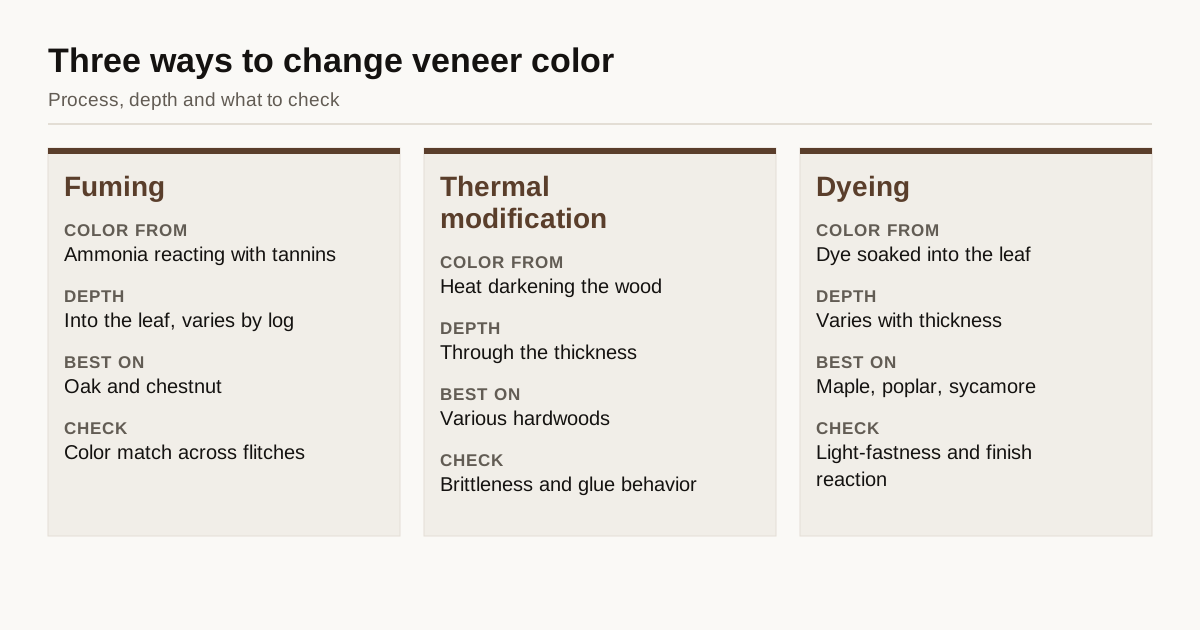
Fuming exposes wood to ammonia vapor in a sealed chamber. Ammonia reacts with tannins in the wood, which turns the surface and the layers below it darker. The effect is strongest in species with high tannin content, with oak and chestnut being the classic examples. A low-tannin wood such as maple barely changes.
Fumed oak is associated with Arts and Crafts furniture, where the deep, smoky brown became a signature. Modern fumed veneer is made by fuming whole flitches or sheets, then selling them in the same way as other veneer. The depth of color depends on exposure time and on the tannin in each log, so two flitches from different logs can come out different even with the same treatment.
Several buyer points follow from the process:
- Color varies by log, so a large order should come from one fuming batch.
- The color change goes into the leaf, but a thin leaf can be changed all the way through while a thick leaf may have a lighter core.
- Fuming is done by the maker in controlled chambers, and the vapor is hazardous, so it is not a shop process. Buy it fumed.
- Fumed color can shift under light, usually lighter with long exposure.
Smoked veneer
“Smoked” is a word without a single meaning. Suppliers use it for different treatments:
- Ammonia fuming, sold under a different name.
- Thermal modification, where wood is heated in a low-oxygen environment, which darkens it throughout and changes some of its properties.
- A stained or dyed look that imitates smoke.
The three processes give different results. Thermally modified wood is darker through its thickness and can be more brittle and less glue-friendly, so ask the maker about pressing. Dyed imitations behave like dyed veneer. Because the label does not tell you the process, ask for it in plain words. A reputable supplier should be able to say how the color is produced and how it holds up.
Dyed veneer
Dyed veneer is soaked or vacuum-treated in a dye solution so that the color penetrates the leaf. This is the method behind blues, greens, reds and grays that do not occur in wood, as well as deep blacks and browns. Light-colored species such as maple, sycamore or poplar are common bases because they take dye evenly.
Dyed veneer is available in two forms. In one, natural wood leaves are dyed and sold as flitches, so the grain of the species shows through the color. In the other, dyed wood is part of a reconstituted block, as covered in the guide to reconstituted versus natural veneer.
Buyer points for dyed veneer:
- Dye penetration varies with thickness and density. Thick leaves may be colored only to a depth, and sanding can expose a paler core.
- Lot-to-lot match depends on the dye batch. Order everything for one project from one lot, and keep a sealed sample.
- Light-fastness differs by dye. Some fade or shift in strong light, particularly reds and blues.
- Finish interaction matters. Some dyes bleed into water-based finishes or react with certain topcoats, so test the full finish system on a sample.
Comparing the methods
| Process | How color forms | Depth | Typical species | Fading and aging | Main check |
|---|---|---|---|---|---|
| Fuming | Ammonia reacts with tannins | Into the leaf, varies by log | Oak, chestnut | Can shift with light | Color match across flitches |
| Thermal modification | Heat darkens the wood | Through the thickness | Various hardwoods | Generally stable color, may lighten in sun | Brittleness and glue behavior |
| Dyeing | Dye penetrates the leaf | Varies with thickness | Maple, poplar, sycamore, others | Depends on the dye | Light-fastness, finish interaction |
| Surface stain | Pigment or dye on the finished panel | Shallow | Any | Depends on finish | Blotching, sand-through |
The figures here are typical tendencies. Maker data and your own sample tests decide the details.
Color matching across lots
Color control is the biggest practical issue with all treated veneer. A project that runs across several shipments needs the same shade each time, and treated veneer shifts more than natural wood from batch to batch because it depends on chemistry. Keep these habits:
- Order the full project quantity from one batch, with a margin for waste and repairs.
- If you cannot, ask the supplier to hold the rest of the batch for later orders.
- Keep a sealed reference sample from the first shipment.
- Compare each new shipment with the sample under the same light before pressing.
- Press and finish a test panel from each new lot.
The guide on what to check in a veneer sample lists the points to look at, and the shipment inspection guide covers what to compare on arrival.
Finishing treated veneer
Treated veneer takes a finish like any other wood, with a few cautions. Deeply dyed or fumed leaves may need no stain at all, only a clear coat. Adding stain on top can muddy the color or stop it from absorbing evenly. Test the finish on a sample from the same lot, because changed color often responds differently from raw wood.
Sanding needs care. Color that is deeper at the surface than in the core can show pale wood if sanding goes too far. The guide on sand-through risk and face thickness explains how to protect thin faces. Use fine grits and light pressure, and stop sanding as soon as the surface is smooth.
For installations in bright rooms, use a finish with UV protection and avoid placing treated veneer in direct sun without it. Window glass blocks some UV, but not all of it.
What to put on an order
A color-treated veneer order should name the process in words, not only the marketing name:
- Species and cut, and the color or the maker’s code.
- Process: ammonia fumed, thermally modified or dyed, as the maker describes it.
- Thickness and backing.
- Lot: whether the full quantity comes from one batch.
- Light-fastness data or a sample for testing.
- Finish: clear, toned or painted, plus any limits from the maker.
- Sealed sample for reference.
Before committing to a large order, ask for a leaf from the batch, press it and finish it with the system you plan to use. Leave it by a window for a few weeks if the installation will be sunny.
Put the color process, the batch and a reference sample in the spec line, as in our guide to veneer specification.
Checklist
- Ask how the color is made, in plain words.
- Order the full quantity from one batch.
- Keep a sealed reference sample.
- Test finish and sanding on the real veneer.
- Check light-fastness for sunny installations.
- Protect the finished surface with a UV-resistant topcoat where needed.
To compare color-treated veneer from several suppliers, send the species, color and thickness on the RFQ page. The request goes to up to three suppliers that stock that species in that form, with a reply within 24 business hours.
Frequently asked questions
What is fumed oak veneer?
It is oak veneer that has been exposed to ammonia vapor, which reacts with the natural tannins in the wood and darkens it, often to a brown or gray-brown tone. The color change happens inside the wood and not only on the surface, and its depth depends on the tannin content and the exposure.
Is smoked veneer actually smoked?
The word is used loosely. Some suppliers use it for ammonia fuming, some for heat treatment and some for a dyed or stained look. Ask the supplier to describe the process in plain terms, and request a sample from the lot you will receive.
Will dyed or fumed veneer fade in sunlight?
Many colors shift with long exposure to light, and dyed woods can fade more than natural woods. Ask the maker for light-fastness data or a sample you can test, and use a UV-protective finish where the installation is sunny.
Know what you need? Send the spec.
Tell us the species, cut, form and square footage. We pass it to up to 3 veneer suppliers that stock it and reply within 24 business hours.
Send my veneer RFQ