Guides / Cuts and Grain
Figured Veneers Explained: Crotch, Burl, Quilted and Curly Grain for Buyers
October 10, 2026
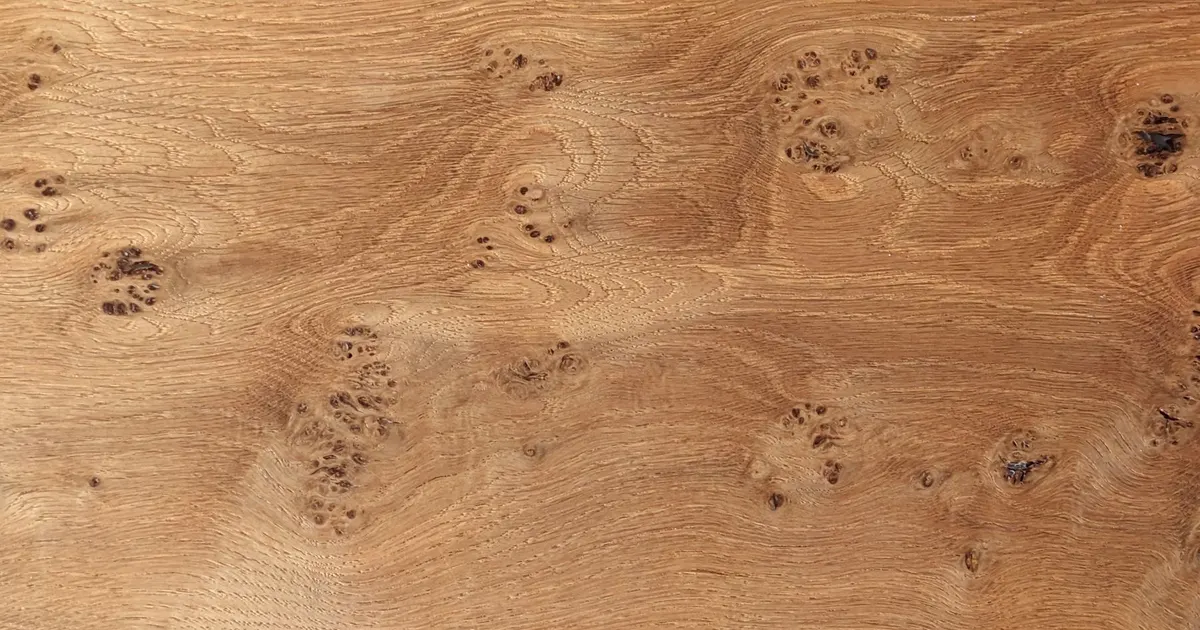
Most veneer looks like what people expect from wood: long grain lines running in a mostly straight direction. Figured veneer breaks that pattern. It shows swirls, eyes, ripples, flames or blisters, and it is what turns an ordinary door or table top into a showpiece. It is also the part of the veneer market where specs are loosest, prices vary most and misunderstandings are most common.
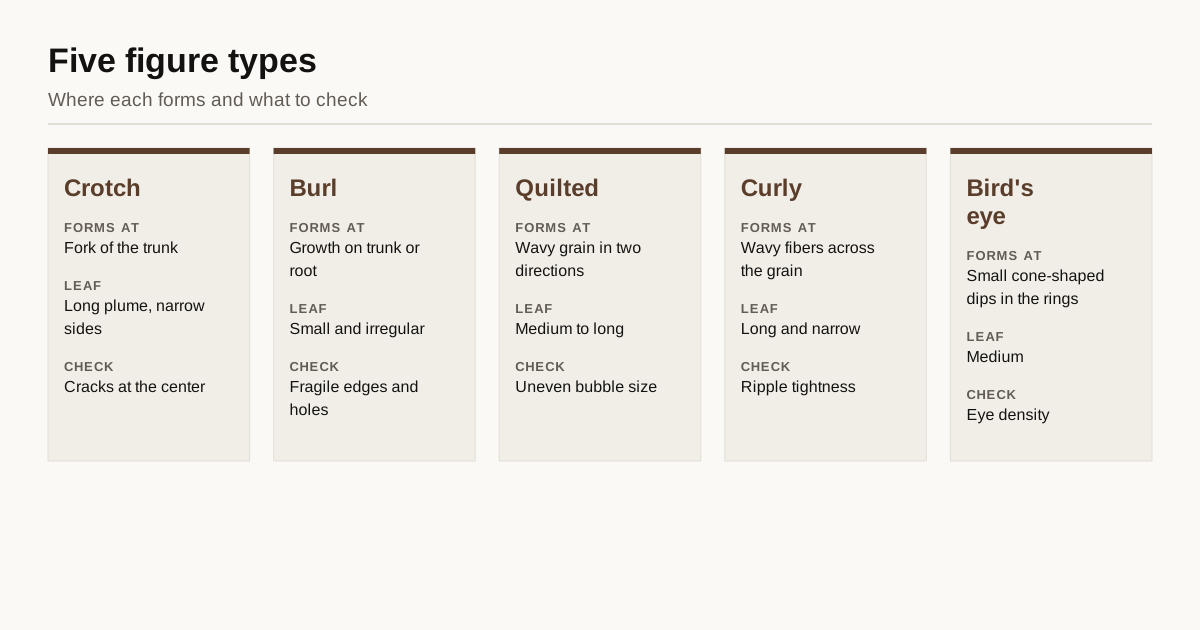
This guide explains the main figure types, where they come from, how they are sold and what to check before ordering. The terms are used a little differently by each supplier, so photos and samples are the final reference.
Where figure comes from
Figure is a change in the wood’s grain pattern caused by how the tree grew. Some figure comes from the position in the tree, such as the fork where a trunk splits. Some comes from a growth deformity such as a burl. Some comes from a genetic or environmental tendency that makes the fibers wave, as in curly or quilted grain.
Figure is not a defect to the buyer, although it may be a deformity to the tree. It makes the wood harder to saw and slice, so supply is limited and the leaves can be small or fragile. The cut matters too, since the same log shows a different figure when sliced a different way. The overview of plain, quarter and rift cuts explains how the knife angle changes what you see.
The main figure types
Crotch
Crotch figure, also called feather or flame in some trades, comes from the fork of a tree where the trunk divides into limbs. The fibers fan out and cross each other, and a slice through the fork shows a symmetric plume or feather. Crotch leaves are typically long in the center and narrow at the sides. Mahogany and walnut crotch are well known, and many other species can show it.
Crotch is often sold as a flitch of consecutive leaves, and the pattern changes gradually from leaf to leaf, so matching in sequence gives dramatic mirrored layouts.
Burl
A burl is a rounded growth on a trunk or root, often caused by stress, injury or infection, in which the grain grows in tight swirls with many small knots, called eyes. Veneer sliced from a burl has a dense, irregular, almost marbled look. Walnut, elm, maple, madrone, redwood, olive and amboyna are among the species sold as burl.
Burl leaves are small, because the growth is limited in size, and fragile, because the grain runs in every direction. They are often sold on a paper or wood backer for support, and many suppliers sell them by the leaf or by the sheet instead of by the flitch. Edges can be ragged, and the patterns rarely repeat, so burl is used for accents, inlays, instrument panels, small tables and statement panels more than for large runs.
Quilted
Quilted figure shows a blistered, three-dimensional pattern across the surface, like a quilt or a field of bubbles. The grain waves in two directions, so light plays across the surface in a changing pattern. Bigleaf maple, sapele and mahogany are commonly sold with quilted figure.
Quilted leaves vary a lot in the size and depth of the bubbles. Some suppliers grade them as light, medium or heavy. The figure shows best under a clear finish that lets light move through the wood.
Curly and fiddleback
Curly figure shows ripples running across the grain, like a washboard, caused by a wavy fiber pattern. It is sometimes called fiddleback because of its use on violin backs. Maple is the best-known species, though other woods can be curly.
Curly veneer has a striped, shimmering look that changes with the angle of view. It is usually cut in a way that shows the ripples at their widest. Leaves are often long and narrow, and the ripples can be tight or wide.
Bird’s eye
Bird’s eye, most common in maple, shows small, round, eye-like spots across the surface. It comes from a growth pattern in which small cone-shaped indentations form on the growth rings. The eyes show when the log is sliced in a plain pattern. Bird’s eye leaves are sold by grade, which depends on how dense and well-formed the eyes are.
Comparing the figure types
| Figure | Where it forms | Typical species | Leaf shape | Sold as | Watch for |
|---|---|---|---|---|---|
| Crotch | Fork of trunk | Mahogany, walnut | Long plume, narrow sides | Flitch or leaf sets | Cracks at the center |
| Burl | Growth on trunk or root | Walnut, elm, maple, madrone | Small, irregular | Leaves or sheets, often backed | Fragile edges, holes |
| Quilted | Wavy grain in two directions | Bigleaf maple, sapele | Medium to long | Flitch or leaf | Uneven bubble size |
| Curly | Wavy fiber across grain | Maple | Long, narrow | Flitch | Ripple tightness |
| Bird’s eye | Cone-shaped indentations | Maple | Medium | Flitch by grade | Eye density |
These are typical tendencies, and each supplier grades differently.
How figured veneer is sold
Figured veneer is sold in several ways, and the price changes with each.
By the flitch. A flitch of figured veneer is a bundle of consecutive leaves from one log section, matched in sequence. This gives the best control over the pattern, since neighboring leaves look alike.
By the leaf or set. Burl and some crotch pieces are sold as individual leaves or small sets, with photos of each. This lets the buyer choose the best pieces.
By the sheet. Some suppliers splice small leaves into larger sheets on a paper or wood backer, which is easier for the buyer to handle. The guide on veneer splicing methods describes how those joints are made.
By the square foot. Common for standard grades of curly or quilted stock, though the price per foot varies widely with the pattern.
Because the leaves differ, ask for photos of the exact leaves or the exact flitch, not catalog images. A photo with a ruler or a known object for scale helps you judge the size of the figure.
Handling and pressing
Figured veneer is more fragile than straight-grain stock. Grain running in several directions makes the leaf more likely to crack or tear when it is bent or handled, and edges are weak. Support the leaf on a flat surface, store it flat and avoid rolling it. A paper or wood backer reduces the risk, and many figured leaves are sold backed.
Moisture matters even more than usual. Figured leaves buckle when wet and crack when dry, so condition them in the pressing room before use. The guide on veneer moisture content at pressing gives typical ranges.
Pressing needs steady pressure and a clean glue line. Figured wood can have uneven density, so glue may soak in unevenly and show as dark patches. A test panel is worth the time. Sanding needs care because figured faces can have soft and hard zones that sand at different rates, which leaves a washboard texture or thin spots.
Finishing figured veneer
Figure shows best under a clear or lightly toned finish. Heavy pigment stains hide the figure and can blotch on figured wood, since density varies. A wash coat or a conditioner can even out absorption. Some finishers apply a dye first and then a clear coat to make the figure more visible. Test on a scrap from the same lot, since figured pieces from different logs finish differently.
What to check before ordering
- Photos of the exact leaves or flitch, with scale.
- Leaf size: length and width, and whether pieces are sold in sets.
- Backing: raw, paper-backed or wood-backed.
- Defects: holes, cracks, voids and bark pockets, plus whether they are acceptable.
- Match plan: leaf-by-leaf layout, book match or random.
- Lot: whether the full quantity comes from one log or one flitch.
- Paperwork: some figured species are regulated, and the guide on veneer paperwork covers common frameworks.
Order a bit more than the layout needs, since figured stock has more waste and replacement leaves rarely match. For matching terms, the grades and matching guide lists the common names.
ANSI/HPVA HP-1 does not apply to recognized decorative patterns such as burl and fiddleback, so name the figure on the spec line, as our guide to veneer specification explains.
Checklist
- Name the figure type and species, and request photos.
- Confirm leaf size and the match you plan.
- Ask whether leaves are backed.
- Plan for waste and extra leaves.
- Condition the stock and press a test panel.
- Keep spare leaves from the same flitch for repairs.
When you know the figure and species you want, send the details on the RFQ page. The request goes to up to three suppliers that stock that species in that form, with a reply within 24 business hours.
Frequently asked questions
Why is burl veneer so much more expensive than plain veneer?
Burls are rare growths, yield small leaves and are fragile, so they take more handling and more waste. A supplier may sell them by the leaf or by the flitch, and the best pieces command a premium. Price depends on species, size and pattern, so ask for a photo of the exact leaves.
Is curly veneer the same as quilted veneer?
No. Curly figure, sometimes called fiddleback, shows ripples running across the grain, like a washboard. Quilted figure has a three-dimensional blistered pattern, like a quilt. Some species can show both, so ask for photos and use the supplier's own grading terms.
Can figured veneer be matched like regular veneer?
Yes, with limits. Many figured leaves are short or irregular, so a four-leaf book match may not be possible. Sequence-cut figured flitches can be matched, while burls are usually laid out leaf by leaf to make the best pattern. Show the supplier the layout you have in mind.
Know what you need? Send the spec.
Tell us the species, cut, form and square footage. We pass it to up to 3 veneer suppliers that stock it and reply within 24 business hours.
Send my veneer RFQ