Home / Veneer cuts
Veneer cuts: how the log is sliced and what each cut shows on the face
Reference hub · Last reviewed October 23, 2026
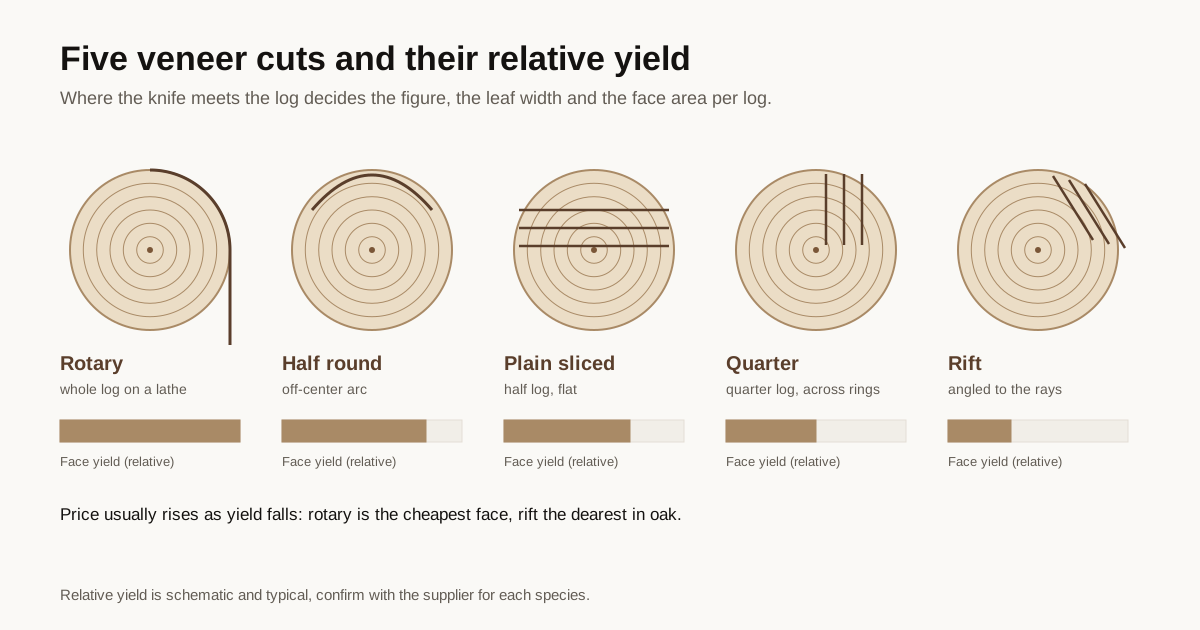
A veneer cut is the way the knife meets the log. The same log can give a broad wild face (rotary), cathedral crowns (plain sliced), a straight stripe (quarter sliced) or tight straight grain without fleck (rift), and each cut also sets the leaf width, the face area per log and the price. Name the cut together with the species on every order, because “walnut” or “white oak” alone describes several very different products.
| Cut | How the log is cut | Figure on the face | Typical leaf width | Face yield per log | Price tier | Typical use |
|---|---|---|---|---|---|---|
| Rotary | Whole log turned on a lathe, peeled as one sheet | Broad, wild, no repeat | Very wide, continuous | Highest | Lowest | Plywood faces and cores, birch and maple panels |
| Half round | Flitch off center on a lathe, cut in a shallow arc | Softer, broader crowns | Wider than plain sliced | High | Low to middle | Large panels, figured species |
| Plain sliced (flat cut) | Half log sliced parallel to a line through its center | Cathedral crowns, straight edges | Often 6 to 12 in | Good | Middle | Cabinets, doors, furniture, most panels |
| Quarter sliced | Quarter flitch sliced roughly at right angles to the rings | Straight stripe, fleck in oak, ribbon in sapele | Often 4 to 8 in | Lower | Middle to high | Millwork, high end casework |
| Rift | Sliced at an angle to the rays | Tight straight grain, little fleck | Often 3 to 7 in | Lowest in oak | High | Modern oak kitchens and walls |
| Comb grain | Rift leaves selected for very straight, even lines | Very straight, uniform | Narrow | Very low | Highest | Specified designer work |
Typical values, varying by species, log and mill. Confirm leaf widths and yield with the supplier for the flitch being quoted.
How the cuts sort: three questions
Every cut answers three questions, and buyers who know which question matters for their job write better RFQs.
1. Peeled or sliced? Rotary and half round cuts are made on a lathe, where the log or flitch turns against a fixed knife. Plain, quarter and rift cuts are made on a slicer, where a flitch moves past the knife one leaf at a time. Sliced leaves come off in order and can be kept in sequence for matching. A rotary sheet is one continuous ribbon with no leaf to leaf repeat.
2. Which way through the growth rings? A knife that runs roughly parallel to the rings (rotary, plain sliced) shows the rings as broad crowns and wild patterns. A knife that runs roughly at right angles to them (quarter, rift) shows them as straight parallel lines.
3. Which way through the rays? Rays run from the pith to the bark. In oak they are large, so a knife running along them (quarter) shows glossy fleck, and a knife crossing them at an angle (rift) hides it. In species with small rays, quarter and rift look much the same, which is why most suppliers only offer rift in oak.
Cut by species: what is usually offered
Not every species is offered in every cut. The table shows what buyers usually find, not a rule.
| Species | Rotary | Half round | Plain sliced | Quarter | Rift | Notes |
|---|---|---|---|---|---|---|
| White oak | Plywood faces | Yes | Yes | Yes, bold fleck | Yes, main market | See white oak veneer |
| Red oak | Common | Yes | Yes | Yes, smaller fleck | Some | Plain sliced is the stain grade standard |
| Walnut | Plywood faces | Yes | Yes | Yes | Limited | See walnut veneer |
| Maple | Very common | Yes | Yes | Some | Rare | Rotary dominates panel faces, see maple veneer |
| Cherry | Some | Yes | Main cut | Some | Rare | Plain sliced is usual |
| Ash | Some | Yes | Yes | Yes | Rare | Quarter shows a calm stripe |
| Sapele | Rare | Some | Some | Main cut, ribbon stripe | No | Quarter gives the ribbon figure |
| Anigre | Rare | Some | Some | Main cut, figured | No | Often figured quartered |
| Birch | Main cut | Some | Some | Rare | No | Rotary for cabinet and plywood faces |
Yield, width and price
The cut is the biggest single lever on face yield. Rotary peeling uses most of the log down to a core. Plain slicing uses most of a half log. Quarter and rift slicing waste more of the flitch to keep the knife at the right angle, and the leaves narrow toward the flitch edges. Fewer square feet of face per log means a higher price per square foot.
Leaf width also sets the seam count. A 48 in wide panel made of 5 in rift leaves has about ten seams, while the same panel in 10 in plain sliced leaves has about five. More seams mean more splicing labor and more chance that one leaf stands out. The post on how much veneer to order shows how cut and leaf width change the waste factor.
How the cut changes the match
| Cut | Usual leaf match | Why |
|---|---|---|
| Plain sliced | Book match | Crowns mirror at each seam, the familiar cathedral look |
| Quarter | Slip or book | Slip avoids alternating light and dark leaves |
| Rift and comb | Slip | Straight lines repeat calmly across the face |
| Half round | Book | Wide crowns, mirrored |
| Rotary | Whole piece or random | One wide sheet, no repeat to match |
For leaf and panel matches, sequence matching across panels and the waste each adds, see veneer matching.
Cut names that confuse buyers
- Flat cut, plain sliced, crown cut: the same cut.
- Quarter cut, quarter sliced, quartered: the same idea. “Quartersawn” is the lumber term.
- Rift and quarter: often sold together as “rift and quartered” in lumber. In veneer they are separate orders.
- Back cut: a variant of half round slicing from the heart side of the flitch, which gives a wider crown. See the post on half round and back cut veneer.
- Comb grain: a selection of rift, not a separate knife setup.
- Flake or flake figure: the trade name for ray fleck on quarter oak.
HP-1 defines the face appearances by result, not by knife angle: rift as straight grain with minimal ray fleck, quarter as straight grain with fleck not limited unless specified. The method of cutting is left to the mill unless the buyer specifies it.
Writing the cut on an order
- Name the cut in the same line as the species: “white oak, rift cut”.
- Add the rule that matters: fleck limit for oak, figure for sapele and anigre, crown for plain sliced.
- State the minimum leaf width if seam count matters.
- State the leaf match that suits the cut.
- Ask for a sample from the actual flitch, finished.
The post on rotary, plain sliced, quarter and rift cut veneer is a shorter comparison of the four main cuts. When the cut and species are set, send them with the RFQ.
Frequently asked questions
What are the main types of veneer cuts?
The main cuts are rotary (peeled from a turning log), half round (an off-center arc on a lathe), plain or flat sliced (a half log sliced parallel to its center), quarter sliced (roughly at right angles to the growth rings) and rift (at an angle to the rays, mainly in oak). Comb grain is a selected, very straight form of rift.
Which veneer cut is the cheapest?
Rotary is usually the cheapest face because a turning log gives the most face area with the least waste. Plain sliced is the common mid-price face. Quarter and rift cost more because the flitch yields fewer and narrower leaves.
Is flat cut the same as plain sliced veneer?
Yes. Flat cut, plain sliced and crown cut are names for the same cut: a half log sliced parallel to a line through its center, giving cathedral figure in the middle of the flitch and straight grain at its edges.
Does the cut affect how the veneer can be matched?
Yes. Cathedral figure from plain sliced faces is usually book matched so the crowns mirror. Straight grain from quarter and rift cuts is often slip matched to avoid the light and dark leaves of a book match. Rotary faces are often a single wide sheet with no match.
Sources
- ANSI/HPVA HP-1-2024, Decorative Hardwoods Association (PDF)
- Wikipedia: Wood veneer
- Wikipedia: Quarter sawing (ray fleck and rift)
Standards, rules and reference books are cited as references, not as claims about Veneer Vendor or any supplier. Veneer Vendor is a matching service: it does not grade veneer, hold stock, issue certificates or file customs papers. Figures are typical. Rules and rates change: confirm with the supplier, your customs broker or the regulator.
Ready to price it? Send one spec.
Give the species, cut, form, grade, match and square footage, plus the papers your market asks for. We pass it to up to 3 veneer suppliers that stock it and reply within 24 business hours.
Send my veneer RFQ