Guides / Ordering
Balanced Panel Construction: Why Veneered Panels Need Backers and Cross-Banding
October 7, 2026
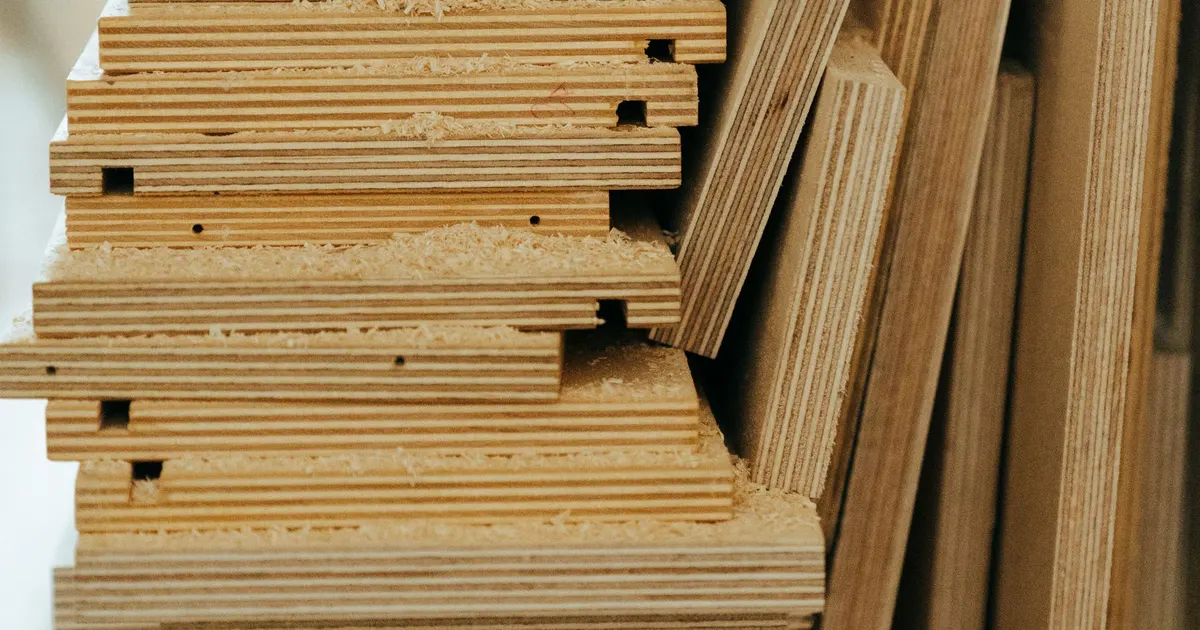
A veneered panel is a sandwich. The visible face is a thin sheet of wood, the core is something stable, and the back has to answer for the face. If the back does not match the face in thickness and moisture response, the panel pulls toward one side as humidity changes, and the result is a cupped door, a bowed table top or a warped wall panel months after delivery.
Balanced construction is the way to prevent that. It is also one of the most common sources of avoidable cost, because buyers who see only the face skip the back and learn the lesson later. This guide explains how a panel moves, what a balancing sheet does, where cross-banding fits and what to specify when ordering veneer for backs.
Why panels warp
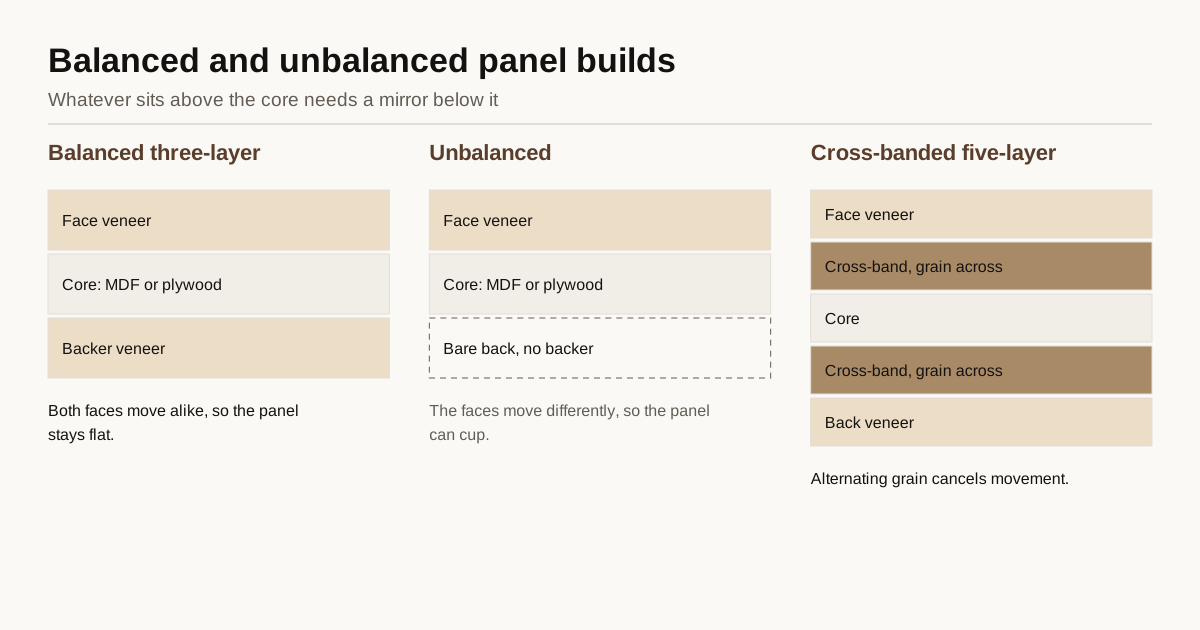
Wood takes up moisture and swells across the grain, and it shrinks when it dries. Along the grain, movement is small. Across the grain, it is much larger. A thin veneer face glued to a core tries to move as the room changes, and the core resists. If both sides of the core are covered by layers that move the same way, the forces cancel and the panel stays flat. If one side is veneer and the other is bare MDF, bare plywood or a coating that breathes differently, the forces do not cancel, and the panel curves.
The effect is stronger with thin cores, wide panels and big swings in humidity. A cabinet door in a steady living room may stay flat on one-sided veneer for years. The same door in a kitchen or a seaside apartment may cup in a season. Shipping through different climates adds to the risk.
Cupping can be slow. A panel may leave the shop flat, look fine on delivery and bend gradually as the coating on one side dries or the room’s heating season changes. That delay is why the problem often lands on the buyer, long after the supplier has been paid.
What a balancing sheet does
A balancing sheet, also called a backer or balancer, is a layer applied to the back of the panel to match the face. It aims for three things:
- Similar thickness to the face veneer.
- Similar moisture response, which means a wood layer or a layer with comparable stability.
- Grain running in the same direction as the face, so both layers move along the same axis.
For many projects the back layer is a lower-grade veneer, allowed to have knots, color variation and defects, since nobody sees it. Using the same species is not required, though it improves the match in moisture behavior. Suppliers often sell a backer in the same species as the face at a reduced grade, in the same thickness, for this purpose.
Other backing options exist for special work. Laminates such as HPL or melamine can balance a veneered face if the panel maker uses a matched pair, though they behave differently from wood. Paper-backed or two-ply wood sheets have their own behavior, as covered in the guide on veneer thickness.
Where cross-banding fits
Cross-banding is a layer of veneer, usually thicker than the face, laid at a right angle to the face grain. It is the classic build of plywood: each layer runs across the one below it, and the alternation cancels most of the movement across the width.
In a three-ply panel, a core runs in one direction and a face and back run in the other. In a five-ply panel, cross-banding sits under the face and above the core. Many veneered panels use a core that already provides balance, such as plywood, so the cross-banding is part of the plywood. Other builds use MDF or particleboard as a stable core, and a face veneer plus a backer completes the balance.
The rule that holds in each build is symmetry. Whatever sits above the core’s center line should have a mirror on the other side, in thickness, grain direction and moisture behavior. A symmetric build stays flatter than an asymmetric one, even if the layers are not made of the same wood.
Common constructions compared
| Build | Typical layers | Stability | Where used | Watch for |
|---|---|---|---|---|
| Face and back veneer on MDF or particleboard | Face, core, backer | Good if backer matches | Cabinet doors, panels | Backer too thin or too dry |
| Face on plywood core, balanced | Face, plywood, backer | Good | Furniture, wall panels | Voids in the plywood showing through the face |
| Cross-banded five-ply | Face, cross-band, core, cross-band, back | Very good | Architectural panels, doors | Cost and thickness |
| One-sided veneer, no backer | Face, core | Poor | Only where fixed to a wall or frame | Cupping and bow |
| Face with laminate balancer | Face, core, HPL or melamine | Fair to good | Casegoods interiors | Different moisture response |
Choosing the core
The core carries a lot of the balance. MDF is smooth and dimensionally stable in plane, but it takes up moisture at the edges. Particleboard is cheaper and less smooth. Plywood is strong and stable when well made, though voids and a rough surface can telegraph through a thin face. Solid cores such as lumber-core are used for some architectural work.
Core flatness matters as much as core type. A face laid over a rippled core copies the ripples. Sanding the core flat, then sealing it, is part of balanced work. The guide on sand-through risk and face thickness explains how a poor core surface leads to thin spots at the sander.
Edges, fixing and the environment
A balanced panel can still move if it is fixed badly or finished badly. Seal the edges, because exposed edges let moisture in faster than the faces do. Finish both faces with the same coating system, since a heavy coat on the front and a light coat on the back creates the very imbalance the backer is meant to remove. Leave room for movement when the panel is fixed into a frame or onto a wall, and avoid trapping it rigidly in place.
For wall panels, back-fixing to a wall with rigid adhesive reduces cupping but pushes movement into the joints. For furniture, a panel in a frame needs space in its grooves. The overview in veneer for cabinets, wall panels and furniture lists how these uses differ.
What to order for backs
Ordering backers is simple if the spec is clear. Include these points:
- Backer thickness matched to the face, for example 0.5 to 0.6 mm to pair with a face of the same thickness.
- Grain direction: parallel to the face grain, which for a rectangular panel usually means the long direction.
- Species: same as the face, or a named compatible species.
- Grade: backer or balancer grade, with limits on holes and splits that could telegraph or glue badly.
- Form: raw leaf, paper-backed or wood-backed, matching the face form where possible.
- Quantity: the same square footage as the faces, plus waste.
Buyers sometimes forget quantity. Backers double the veneer area for a two-sided build, and they need their own waste allowance. A short quantity at the press stops a run as surely as a missing face.
Ask suppliers whether they stock backers in your species and whether they ship them with the faces or separately. Ordering both from one lot reduces mismatch in thickness and moisture. The pricing factors guide shows how grade and species change cost, and backers are usually the cheapest part of the order.
Troubleshooting a warped panel
When a panel cups, check the basics first. Is there a backer, and is it the same thickness as the face? Is the grain running the same way on both sides? Was one side finished more heavily than the other? Did the panel sit on a surface that blocked air on one face? Is the humidity different on each side, as with a panel against an outside wall?
A panel that cups slightly and then flattens with a seasonal change is a sign of moisture imbalance and can often be managed with finish and fixing. A panel that holds a permanent set probably has a structural imbalance, such as a thin or missing backer, and usually needs to be remade. Photos with the build details help a supplier work out whether the veneer is part of the cause.
Checklist
- Plan the build as a symmetric stack around the core.
- Order a backer in matching thickness and grain direction.
- Choose a core that is flat and stable for the use.
- Finish both faces and edges with the same system.
- Allow for movement when fixing the panel.
- Include backer quantity and waste in the order.
For veneer faces and backers quoted together, send the details on the RFQ page. The request goes to up to three suppliers that stock that species in that form, with a reply within 24 business hours.
Frequently asked questions
Do I need a backer if I only see one face of the panel?
In most cases yes. A panel with veneer on one side and bare core on the other can cup as humidity changes, because the two faces take up and lose moisture at different rates. A balancing sheet on the hidden side, or a laminate with similar behavior, keeps the panel flat.
Does the backer have to be the same species as the face?
Not necessarily. The aim is similar thickness and similar moisture response, with grain running the same direction as the face. Many shops use a lower-grade veneer of a compatible species, sold as a backer or balancer, and save the show species for the visible side.
What is cross-banding in a veneered panel?
Cross-banding is a layer of veneer laid with the grain at a right angle to the face. In a classic three-ply or five-ply plywood-style build it sits under the face and counters the movement of the face across the width, which stabilizes the panel.
Know what you need? Send the spec.
Tell us the species, cut, form and square footage. We pass it to up to 3 veneer suppliers that stock it and reply within 24 business hours.
Send my veneer RFQ